

Baumol's Cost Disease: Why Cheaper AI Will Make Some Things Wildly More Expensive
Last week, we looked at Jevons Paradox. Why making AI cheaper doesn't shrink AI usage but explodes it. Cheaper inference, more inference. Cheaper tokens, more tokens. That's the demand side of the story, and it's the one Satya Nadella, Travis Kalanick, and most of tech Twitter have been telling.
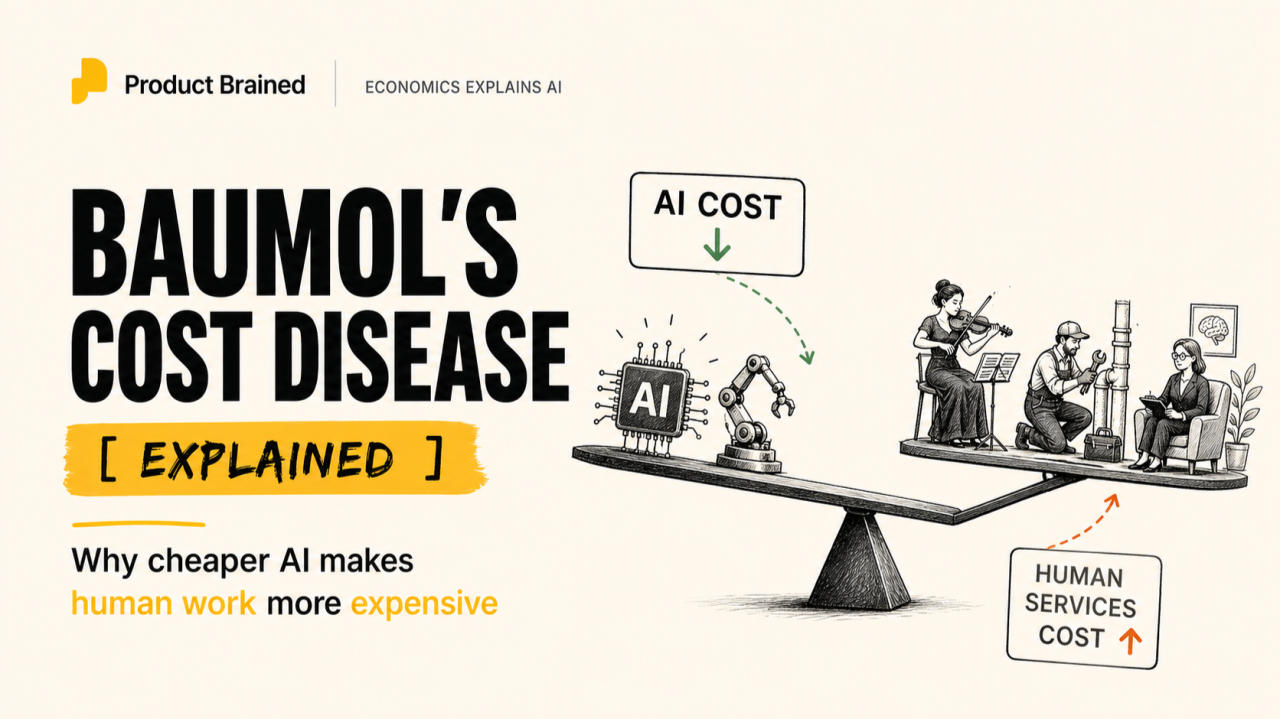
Part 2 of the "Economics Explains AI" series. Read Part 1: Jevons Paradox here.
Last week, we looked at Jevons Paradox. Why making AI cheaper doesn't shrink AI usage but explodes it. Cheaper inference, more inference. Cheaper tokens, more tokens. That's the demand side of the story, and it's the one Satya Nadella, Travis Kalanick, and most of tech Twitter have been telling.
But there's a flip side almost no one is pricing in: when one input gets dramatically cheaper, other things get dramatically more expensive. Not despite the efficiency. Because of it.
Meet Baumol's Cost Disease.
The String Quartet That Explains Everything
In 1966, economist William Baumol noticed something strange. It still takes four musicians the exact same 40 minutes to perform a Beethoven string quartet today as it did in 1826. Zero productivity improvement in 200 years.
Yet the musicians' wages have risen enormously over the same period.
How? Because the rest of the economy got more productive. As manufacturing, agriculture, and software improved, workers in those sectors earned more. To stop musicians from quitting and becoming engineers, orchestras had to keep raising pay even though musicians weren't producing any "more" music per hour.
That's Baumol's Cost Disease in one line: when productivity surges in one sector, wages in low-productivity sectors rise too, making those services dramatically more expensive in real terms.
It's why college tuition, a hospital visit, a babysitter, and a haircut have all outpaced inflation for decades. It's not inefficiency. It's the predictable shadow of efficiency happening somewhere else.
Now Apply It to AI
If Jevons is right, AI is about to become the most efficient productivity engine in human history. Trillions of cognitive tasks, performed for pennies.
Baumol tells us the second-order effect with precision: anything AI can't do well is about to get astonishingly expensive.
Three categories will feel this first:
1. High-touch human work. Eldercare. Childcare. Plumbers, electricians, dental hygienists, and in-home nurses. Jobs where physical presence and judgment under uncertainty matter. AI can't show up at your bathroom at 11 pm. And the labor pool that can is being drained by every other sector bidding for human time. Expect prices to go vertical.
2. Judgment-as-a-feature work. Senior engineers who decide what to build (not just how). Doctors who own the diagnosis. Lawyers who carry the liability. As AI commodifies execution, judgment becomes the scarce input and gets repriced accordingly. The middle of these professions is in trouble. The top is about to make a fortune.
3. Verifiably human goods and services. Hand-thrown pottery. Live concerts. A meal cooked by a chef you can see. A novel you know was written by a person. These become luxury goods not because they're better, but because they're certifiably scarce in an AI-saturated world. Expect a "Made by Humans" premium to emerge across every category the way "organic" did for food.
The Strategic Read
Most people are asking the wrong question. They're asking: "Will AI take my job?"
The Jevons + Baumol combo suggests a sharper question: "Is the value I produce about to get cheaper or more expensive?"
- If your value is execution that AI can replicate your hourly rate is heading toward zero. (This is the bad news Jevons hides inside the good news of "more demand for AI.")
- If your value is judgment, taste, accountability, physical presence, or trust your hourly rate is about to go through the roof. Baumol says so.
The gap between these two groups is going to be the defining inequality story of the next decade. We're already seeing the leading edge of it: junior coding tasks collapsing in price while staff engineers see record offers. Customer service tickets falling to bots while a great therapist has a six-month waitlist.
Bottom Line
Jevons explained why a world of cheap AI means infinitely more AI.
Baumol explains why that same world will make a great plumber, a great therapist, and a great judgment-caller more valuable than they have ever been.
The cheap thing gets cheaper. The expensive thing gets more expensive. Both are happening at the same time, for the same reason.
Pick your side carefully.
Next week: Amara's Law, why we're simultaneously overhyping and underhyping AI, and how to tell which mistake you're making.
If this resonated, hit subscribe and share with one person who's trying to figure out where to point their career next.