

Why every PM building with AI needs to understand Jevons Paradox
In 1865, an English economist noticed something deeply counterintuitive: making steam engines more efficient didn't reduce coal consumption. It exploded it. That same dynamic is quietly reshaping every AI product decision you're making right now.
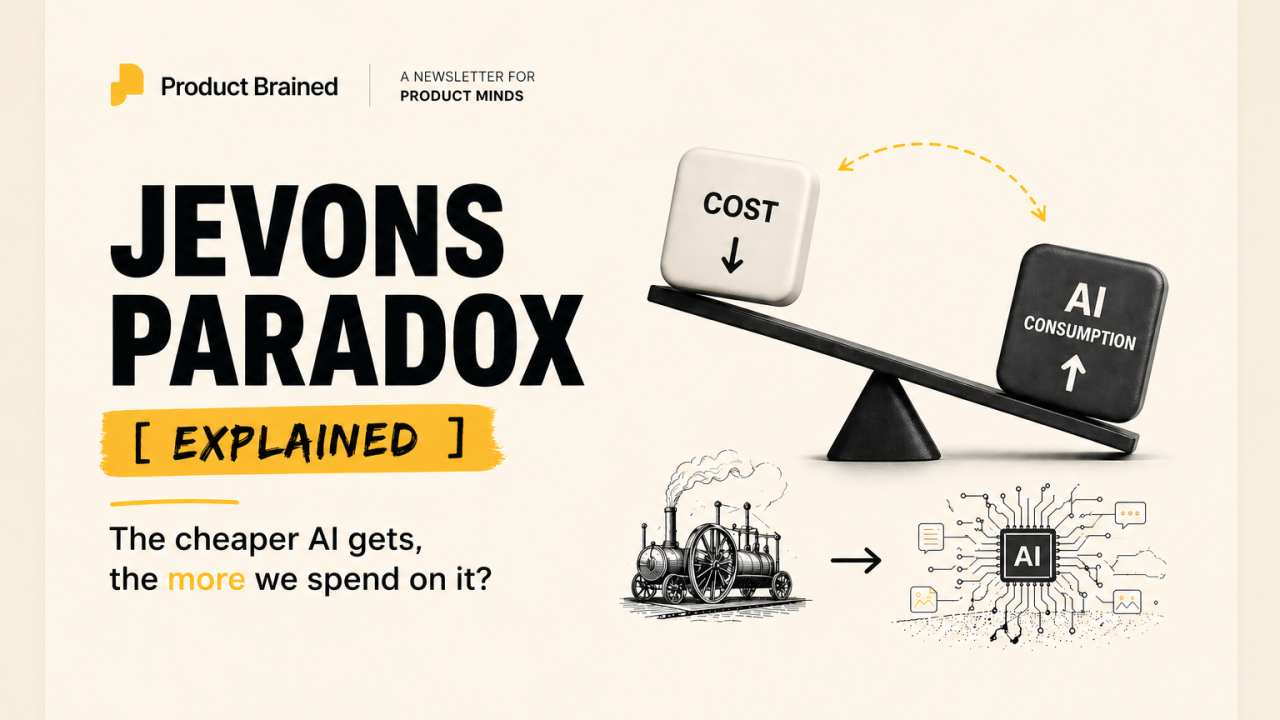
Why every PM building with AI needs to understand Jevons Paradox before building.
In 1865, an English economist noticed something deeply counterintuitive: making steam engines more efficient didn't reduce coal consumption. It exploded it. That same dynamic is quietly reshaping every AI product decision you're making right now.
The Origin Story
A paradox born in the coal mines
William Stanley Jevons published The Coal Question and dropped one of economics' most enduring observations: efficiency gains in resource use tend to increase total consumption of that resource, not decrease it.
The Jevons Paradox, in plain English
When something becomes cheaper or easier to use, people use so much more of it that total consumption rises, even as each individual use becomes more efficient. Efficiency unlocks demand that simply didn't exist before.
Better steam engines meant factories that previously couldn't afford steam power suddenly could. New use cases opened up. More mines were built, not fewer. Coal consumption skyrocketed instead of falling.
Why This Matters Now
AI tokens are the new coal
Token prices have dropped over 99.7% since GPT-3's launch ( Sounds crazy, I know, source here ). Every time a model gets cheaper, you'd expect companies to spend less on AI. Instead, the opposite happens. More features get built. More users get access. More prompts get chained together. More data gets processed in bulk.
"We made it 10x cheaper, so they used 100x more of it." Every AI infrastructure team in 2026.
This is Jevons Paradox running live in your product. And if you're not planning for it, you'll get caught flat-footed in three different ways: your cost models will be wrong, your scaling assumptions will be wrong, and your product will miss the use cases that cheaper AI makes possible for the first time.
The PM Playbook
What to do with this as a product person
01) Rewrite your cost model: Token cost going down does not mean AI spend goes down. Plan for consumption to scale non-linearly as usage grows.
02) Hunt for unlocked use cases: What was too expensive to build at $0.10/1K tokens becomes viable at $0.001/1K. Those gaps are your next features.
03) Build for volume, not scarcity: Design UX for heavy usage. Rate limits and friction that made sense before are becoming user experience debt.
04) Rethink your pricing model: If margins are tied to token pass-through pricing, a 10x drop in API cost is a 10x hit to your revenue ceiling. Get ahead of it.
The Bigger Picture
History keeps rhyming
Jevons in the wild
1865: Efficient steam engines make coal cheaper to use. Coal consumption triples within a generation.
1970s – 1990s: Fuel-efficient cars lead to more driving, more roads, and more suburban sprawl than ever before.
2000s: Efficient data compression makes streaming cheap. Global bandwidth consumption explodes.
Now: Cheaper tokens create agentic workflows, multi-model chains, and entirely new product categories that didn't exist two years ago.
The pattern isn't going to stop. As reasoning models get faster and cheaper, we won't use fewer of them. We'll pipe them into every corner of our products, run them in parallel, and build workflows we genuinely couldn't have imagined charging for in 2022.
The PMs who see this coming are already asking: "What becomes possible to build when tokens are effectively free?" That's the right question. The wrong one is "How do I spend less on tokens?"
Efficiency doesn't reduce demand. It creates it. Build your Product accordingly.